AGENTS.md Starter Templates
Seventeen copy-ready AGENTS.md execution contracts covering the common repository shapes, stacks, and risk levels — plus the selection matrix, composition rules, and validation checklists that keep them honest.
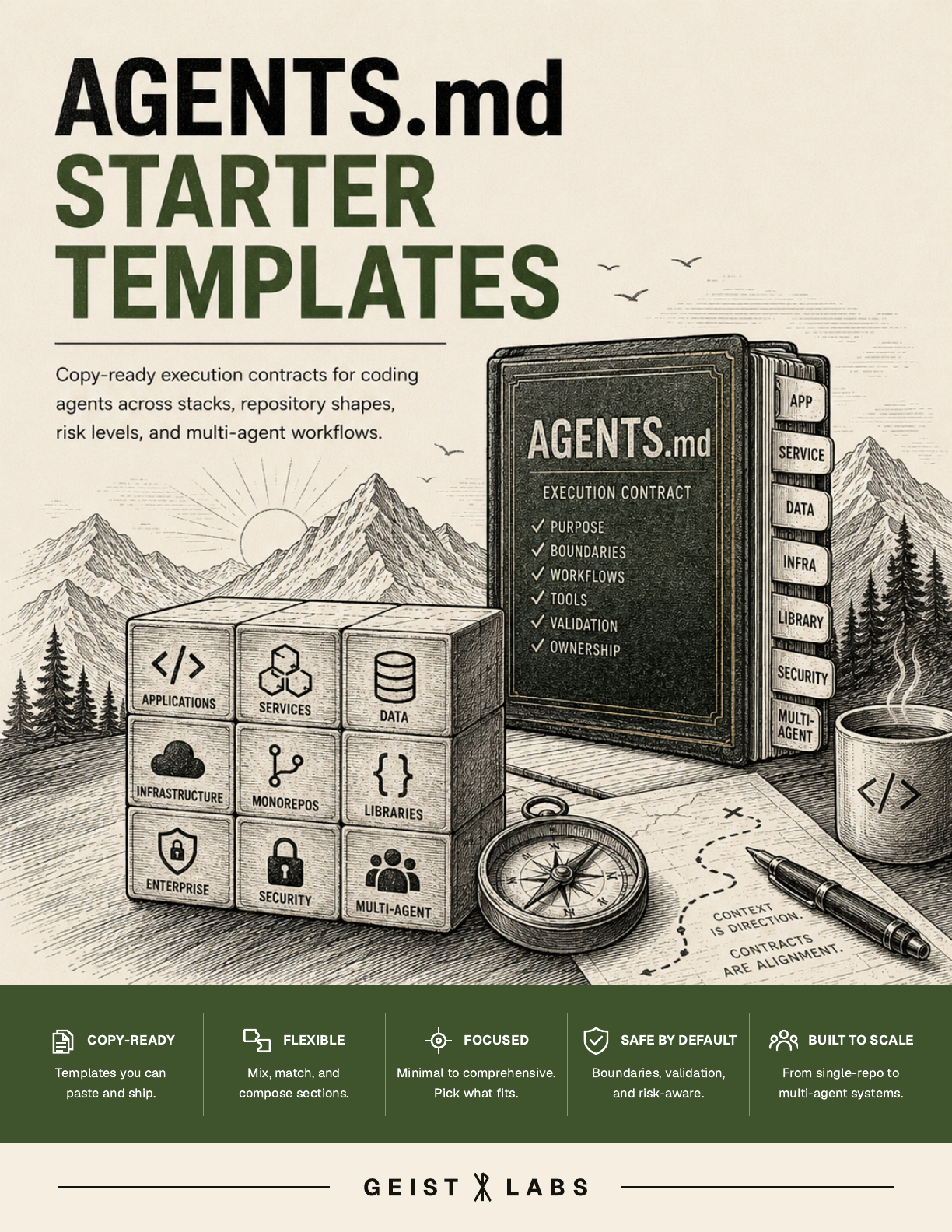
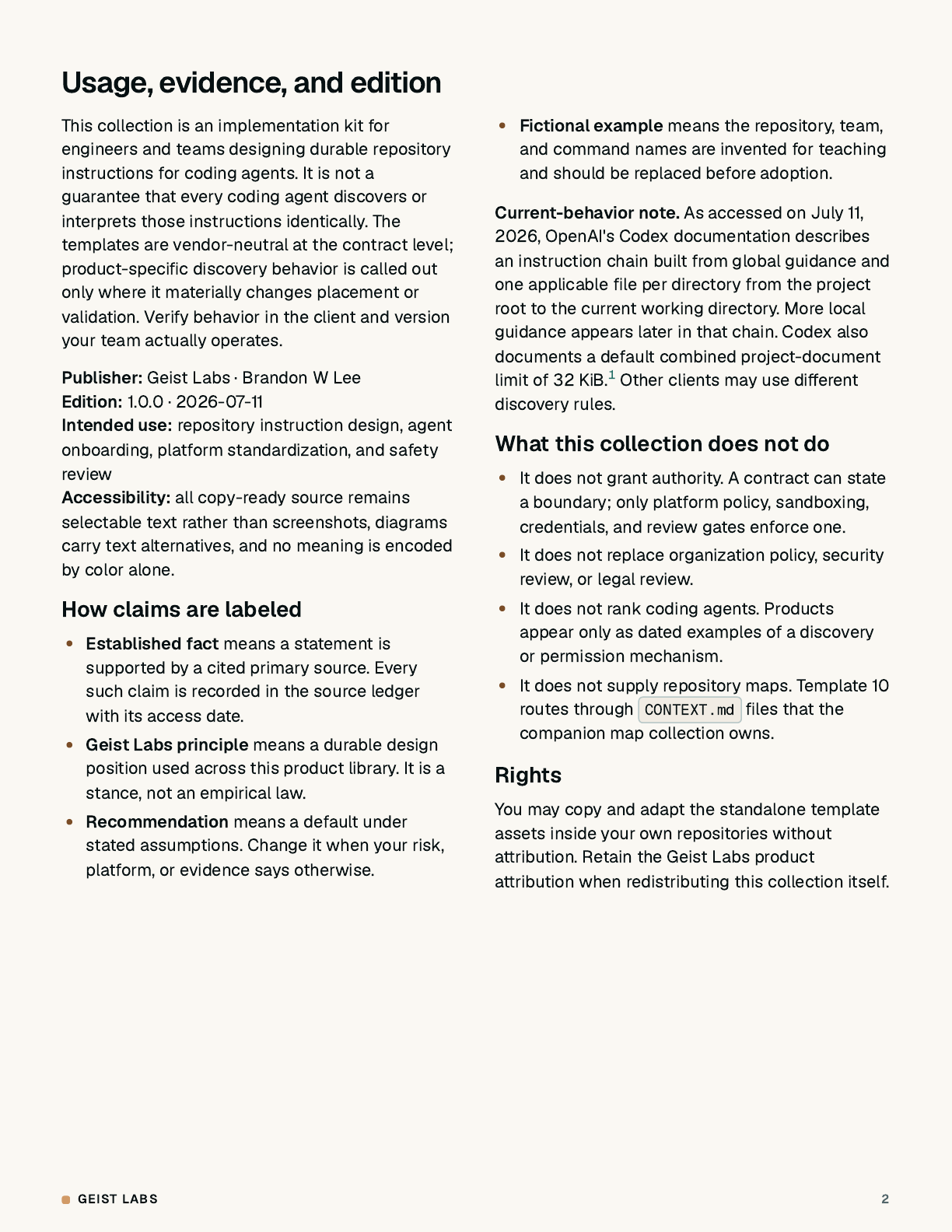
An implementation kit, not a reading book. Seventeen complete contracts run from Minimal and Comprehensive through single-stack applications, monorepo roots and nested apps, infrastructure, data, documentation, libraries, enterprise policy, security-sensitive work, and multi-agent lanes. Written for engineers introducing coding agents to an existing repository, platform teams standardizing repository instructions, and technical leads designing safe agent workflows.
Every template ships three times over: the complete source, a page of customization guidance covering its consequential sections, edit order, common mistakes, and companion files, and a validation checklist you run before adoption. A shared marker grammar makes required and optional values unmistakable, and the safety guidance is explicit that a contract states a boundary but never grants authority — permissions belong in platform policy, sandboxing, credentials, and review gates. Vendor-neutral at the contract level, with product-specific discovery behavior called out only where it changes placement or validation.
What's inside
- 17 complete contracts · 01 Minimal, 02 Comprehensive, 03 Small application, 04 Next.js frontend, 05 Backend service, 06 Go CLI, 07 Python service
- 08 Monorepo root, 09 Nested monorepo application, 10 Repository using nested CONTEXT.md, 11 Infrastructure as code, 12 Data engineering
- 13 Documentation repository, 14 Library or SDK, 15 Enterprise repository, 16 Security-sensitive project, 17 Multi-agent workflow
- Every template also as a standalone Markdown file, so exact whitespace survives the copy
- Per-template guidance: consequential sections, a customization order, common mistakes, suggested companion files, and a validation checklist
- A 17-row selection matrix, four-question decision guide, and intake checklist for choosing the smallest contract that fits
- Composition rules — reusable blocks, required vs. optional vs. routed sections, instruction hierarchy, first-step routing, and contradiction and precedence review
- Worked examples for reducing an oversized contract and correcting a root/local conflict, plus a seven-step migration procedure
- A cross-template validation checklist, event-driven maintenance cadence, 4 original diagrams, a quick index, and a cited source ledger
- Rights to copy and adapt every template inside your own repositories, without attribution
Questions teams ask
Do I get the templates as files, or only as pages in a PDF?
Both. All 17 contracts appear in full inside the 97-page PDF, and each one also ships as its own standalone Markdown file so exact whitespace and markers survive the copy. Copy the file, not a PDF page, into the path where the instructions should apply.
Can I use these templates in my company's private repositories?
Yes. You may copy and adapt the standalone template assets inside your own repositories without attribution. The requirement to retain Geist Labs attribution applies only to redistributing this collection itself.
Which template should I start with?
The narrowest one whose assumptions match the repository — not Comprehensive because it feels safer. A 17-row selection matrix and a four-question decision guide make the call for you, and the composition rules cover adding a bounded risk module rather than stacking whole templates.
What is the difference between prompt engineering and AI Systems Engineering?
Prompt engineering tunes individual model requests. AI Systems Engineering designs the context, workflow gates, review loops, and operating memory that make AI-assisted work repeatable across a team.