The Complete AI Systems Engineering Handbook
The discipline-level volume of the AI Systems Engineering Library: a complete operating model for turning AI coding tools into reliable, secure, observable, and cost-aware engineering capability.
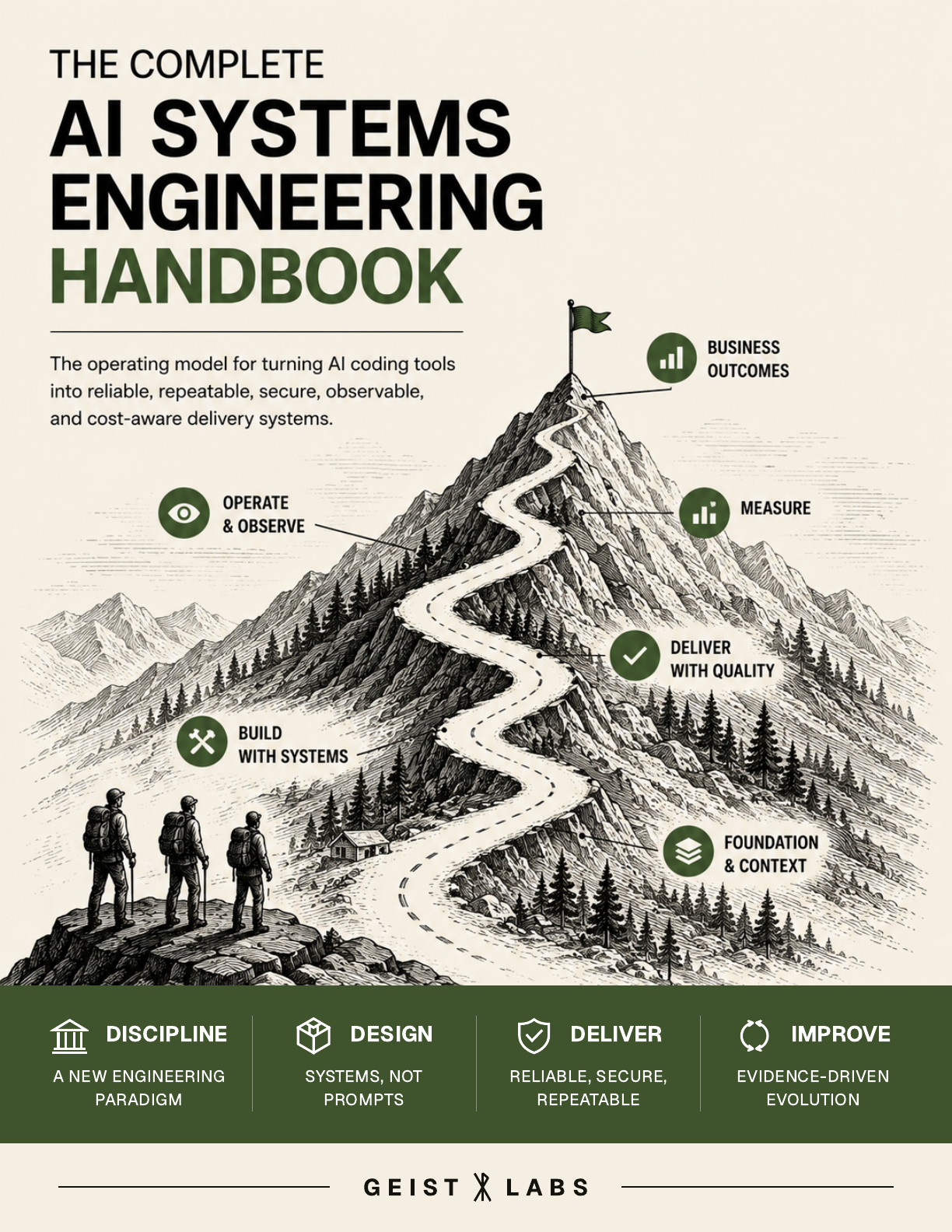
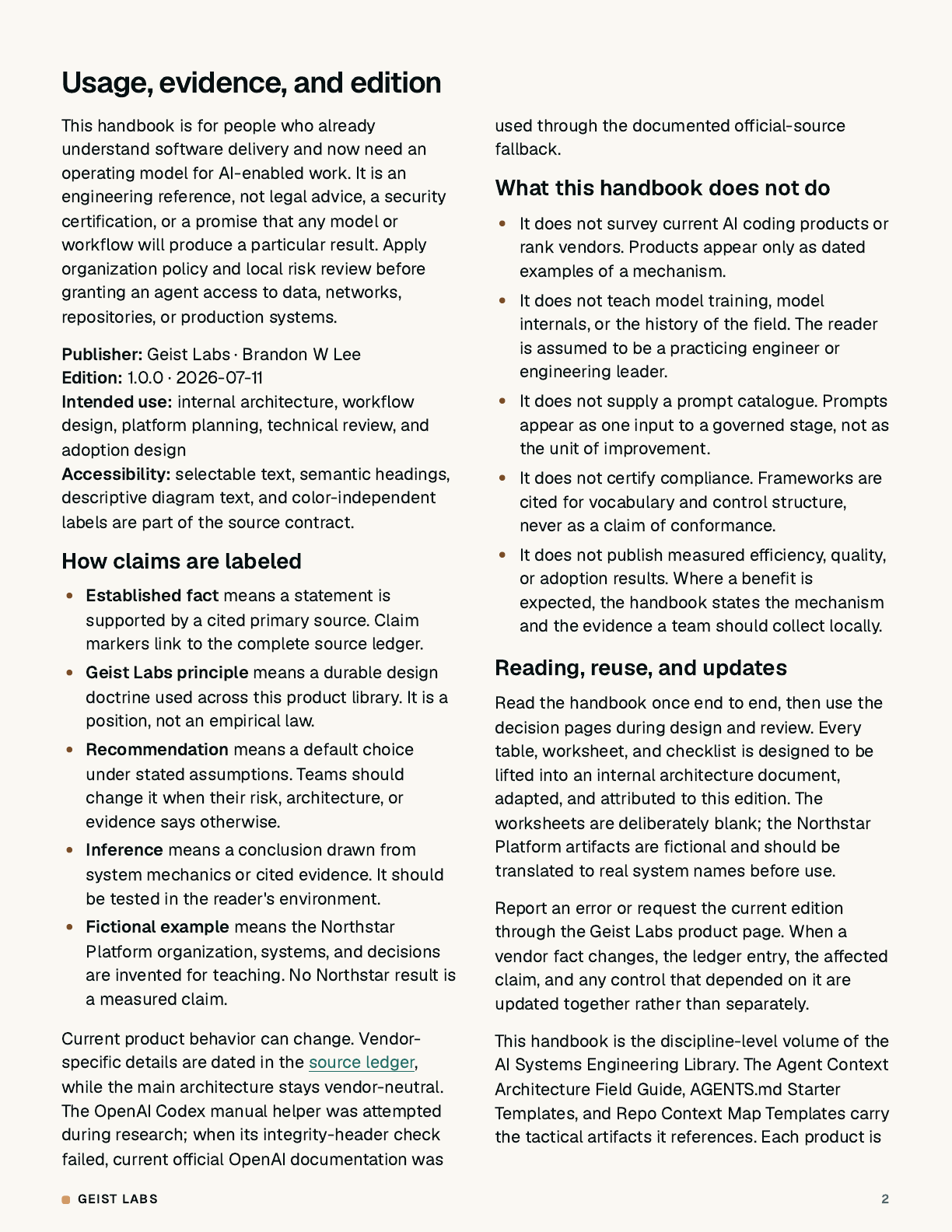
Fourteen chapters across five parts, from why prompt-centric work breaks at scale to a five-stage maturity model and a phased roadmap. Written for senior, staff, and principal engineers, architects, and the platform, security, and engineering leaders accountable for AI-enabled delivery — with four reading paths so each role knows which chapters to open first.
Every chapter moves the same way: the principle that survives tool changes, the reusable pattern, a concrete implementation, and the evidence that proves it works. The diagrams, tables, and worksheets are built to be lifted into your own architecture documents, and a fictional Northstar Platform carries one organization's decisions across all fourteen chapters. Vendor-neutral throughout, with external claims dated and cited.
What's inside
- Part I · Why prompt-centric work fails at scale — six hidden failure mechanisms, and the nine components of the system around the model
- Part II · Context as infrastructure — the context control plane, source-selection rules, and repository instructions as an execution contract
- Part III · Workflow architecture — stage contracts, deterministic vs. probabilistic boundaries, tool trust zones, and permission decisions
- Part IV · Reliability and learning — validation and recovery loops, a failure taxonomy, evaluation design, and a working cost model
- Part V · Scale — multi-agent topologies, enterprise reference architecture, governance, adoption measurement, and a five-stage maturity model
- 14 original diagrams, 39 decision tables, and blank worksheets, checklists, and scorecards you can adapt
- Appendices, a 32-term glossary, a cited source ledger, and a 30/60/90-day implementation roadmap
Questions teams ask
Who is the handbook for, and what does it assume?
Senior, staff, and principal engineers, software and platform architects, and the engineering, productivity, and security leaders accountable for AI-enabled delivery. It assumes working knowledge of version control, code review, CI, and how your organization approves production change — not prior experience with agent frameworks or evaluation harnesses.
How does it relate to the other Geist Labs resources?
The handbook owns the discipline: reference architectures, controls, governance, economics, and the maturity model. The Agent Context Architecture Field Guide and the AGENTS.md Starter Templates carry the tactical artifacts it references, so nothing is duplicated between them.
What is the difference between prompt engineering and AI Systems Engineering?
Prompt engineering tunes individual model requests. AI Systems Engineering designs the context, workflow gates, review loops, and operating memory that make AI-assisted work repeatable across a team.